Indian viewers have not yet been given freedom from Akshay Kumar during the week of Independence Day celebrations, despite the fact that India’s Independence Day will be celebrated in a few days. In the last seven years, there have been six films of this kind. You can’t help but wonder whether it will take a letter from the Prime Minister to finally get his attention. From the Office of the President? A letter from the Prime Minister and President of the United States? An armed rebellion? It’s possible that I’m not asking the right questions. Perhaps all of us are caught up in a gigantic thinking experiment that begs the question, “Did we ever obtain freedom if Kumar did not release a film on the week of Independence Day?”
Even if you exclude his distinctive avatar, his more recent career can be broken down into two main categories: patriotic films and feminist films. The name of his most recent album, Raksha Bandhan, gives a clear indication of the album’s purpose. It is a movie that is so expertly terrible that even if it competed against itself in a 100-meter dash, it would still come in second place. I’m trying to figure out where I should get started.
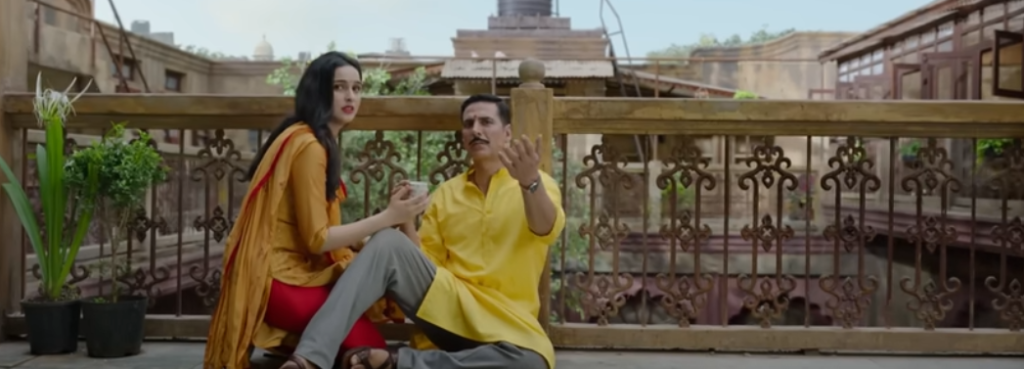
The proprietor of a chaat shop in Chandni Chowk known as Lala Kedarnath (Kumar) is well-known for selling a unique variety of golgappa. According to legend, if a pregnant woman consumes one of his golgappas, she will give birth to a son. There are a lot of ladies waiting in line in front of his establishment. Lala is consumed by one goal, or perhaps it’s more accurate to call it an obsession: he is fixated on marrying off his four sisters, and he does not stop thinking about it. Aanand L. Rai is a filmmaker who takes a concept and continues to pound on it until the idea itself begins to cry for a break. And everyone is included by that ‘concept.’ The residents of Chandni Chowk, are you there? All sexists. How many of them feel that dowry is acceptable? Everyone of them. What are the topics of their conversations? Marriage – each and every one of them, at all times. These people are so badly developed that if you had to write a Cliff Notes summary of their existence, it would scarcely be more than a phrase. A typical response from Lala would be something along the lines of “sexist, dumb, condescending (lol)”.
The movie gives a “concise” description of the three sisters, including that they are overweight, black, and full of angst, as well as “daayan” and “chudail.” It should come as no surprise that “sabse honhaar” is the most attractive of the bunch. Every single scene, I repeat, every single scene, is turned up to a decibel level that is so high that the movie leaves behind a sea of dead knobs. Rai is a filmmaker who is extraordinarily inept and arrogant, and he believes that he has discovered a formula for making films that are unpleasant but ‘funny,’ but ultimately progressive (so back off – don’t dare critique it). It seems as if he is not so much producing a picture as he is attempting to provoke, trying to pinch the “woke” audience, and assuming that the climactic detour will exonerate him of any wrongdoing. But here’s the thing: His movies have had a Proud Incel Energy for such a considerable amount of time that, in Raksha Bandhan, he reveals himself for the first time.
The only character other than Rai’s that is revealed through the gags is Rai himself, and hardly none of them disclose characters or move the plot along. Instead, the gags are heaped on merely for the joy of it. They don’t even make for a good joke. The following is only a (very) short sample: The dowry rate is being discussed over the phone by the uncle of a potential suitor, and Lala keeps increasing the amount, making the entire thing seem like an auction. One sometimes refers to an obese lady as a “undertaker.” Shaming people for their weight is this movie’s obsession: The sister of Lala is told by the matchmaker Shaanu (played by Seema Pahwa) that in order to be regarded suitable for marriage, she must transform herself from “Sunny Deol” into “Sunny Leone.”
Many portions make no sense at all. He gets the impression that she wants to take him out on a date when she asks Lala what he has planned for the evening and says she wants to see him to talk about his sisters’ weddings. There is a significant portion of Lala’s monologue in which she makes fun of a man who stutters. When a guy harasses Lala’s sister, Lala’s brother beats the man and then gets a megaphone and says, “Every eve teaser will be forced to marry the lady he harasses.” The man who harassed Lala’s sister was Lala’s sister.
The whole film exudes the icky atmosphere of a Mithun play from the 1980s. Lala has made a solemn vow to his mother that he would not wed before any of his sisters. Himesh Reshamiya is responsible for the music, and the tunes are choppy and easy to forget. It’s the type of movie that would find it humorous if a guy was dressed as a woman and imitating her voice and mannerisms. In spite of the fact that the film presents itself as being anti-dowry and even includes a lengthy sermon at the film’s conclusion, the movie grants its female characters very little autonomy. The four sisters are seen throughout the movie, but we are never given any information on who they are or what their goals in life are. Even Sapna, who was Lala’s childhood love and is played by Bhumi Pednekar, centres her life on the men in it. First it was Lala, pleading with him to marry her; next it was her father, who was so enraged by Lala’s rejection that he put her in front of a number of potential husbands. Lala’s strange preoccupation is not challenged by Sapna or the sisters in any way.
But even if Raksha Bandhan had been aware of the gender politics inherent in its celebration, it would have been intolerable for the simple fact that almost nothing about it makes sense. There are also strange jumps of logic in it, such as when Lala is having trouble coming up with the money for his sisters’ dowry, yet when he wants to impress Shaanu, he goes to a dealership and buys a vehicle for her. Its concluding twists are so outlandish – concentrated on how Lala handled the money and changed – that you begin to question whether or not this style of screenplay is really allowed in the industry. When the movie becomes sad, it gets very sad: for about 10 minutes straight, more than half a dozen characters break down and weep nonstop.
Raksha Bandhan is consistently shown in a less favourable light with each new scene. It is needy, under confident, and absurd — it is an experience that is mind-numbing, as if viewing six awful films for the price of one. It is weak, laboured, and unsophisticated. It is even off-putting. Even when it is at its most respectful, it is condescending. It is a pitiful advertisement for the public service, and it goes out of its way to soothe, uplift, and mollycoddle Lala. You may be wondering what the purpose would be in casting anybody other than Kumar. When you see him in this pose, he seems to be so worn out that you begin to lose interest after a while. However, we wouldn’t have had a problem with that at all. At the very least, the movie would have been truthful. Kumar had the opportunity to play a variety of roles, including the four sisters, his love interest, her father, his bike, the golgappa, and of course the rakhis. It would not have made a difference since he has been performing for crowds for such a significant amount of time.
