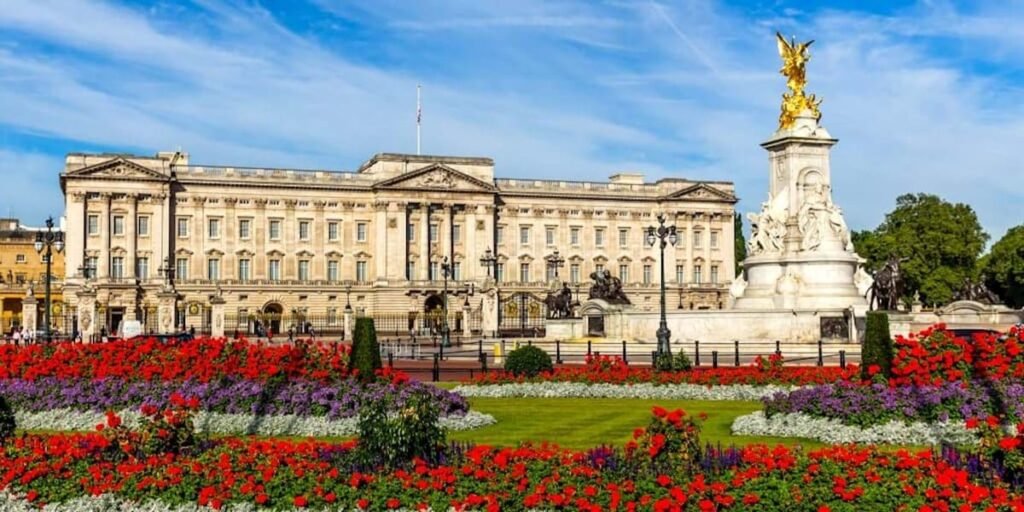
Buckingham Palace is synonymous with England. The sumptuous London property is located in the heart of Westminster, bordered by St. James and Green Parks, and serves as the official residence of the monarch of the United Kingdom (UK). It is one of the most famous buildings in the United Kingdom and Europe, and it has been in countless films and television series. We present you with 5 interesting facts about Buckingham Palace.
5 interesting facts about Buckingham Palace
1. Originally built for a Duke
Buckingham Palace is connected with England’s monarchs and queens. However, it was not designed for or by them. John Sheffield was the first Duke of Buckingham, taking the throne in the early 18th century. He ordered the demolition of an old mansion in Westminster in 1703 and the construction of a new palace on the same site.
Buckingham House was later purchased by King George III in 1761 to give his family a private home adjacent to St. James’ Palace. Queen Victoria made Buckingham Palace her official residence when she ascended to the queen in 1837.
2. Security breaches by a teenager
Buckingham Palace is one of the most important structures in England. To some extent, it is the country’s equal to the White House, yet the security crew couldn’t stop a youngster named Edward Jones from having a blast in the building.
Jones, dubbed ‘the young Jones’ by English newspapers, broke into the building three times between 1838 and 1841. He sat on the elusive royal throne by stealing food from the palace kitchen and Queen Victoria’s pants from her chamber. Jones’ success attracted imitators, including Michael Fagan, who broke into the palace in 1982.
3. The terrors of World War II reached Buckingham Palace
World War II wreaked widespread devastation throughout Europe. Museums, government buildings, and heritage structures, as well as thousands of civilian residences and apartments, were razed.
Buckingham Palace was also bombed during the war, despite its significance to England’s heritage and history. The British government advised King George VI and his family to leave the palace, but they elected to stay. Queen Elizabeth explained the choice at the time, saying, “The children will not leave unless I do.” I will not leave the kingdom unless their father does, and the king will not leave the country under any circumstances.” They remained steadfast despite nine direct hits on the palace by German planes.
4. It’s a village in itself
Buckingham Palace’s size and functionality are absolutely astounding. It is spread out across 39 acres, with lovely gardens encircling the grand mansion. Inside the palace, the royals will find everything they require. Buckingham Palace is like a village or tiny town in and of itself, including everything from a post office to a movie theatre, police station, and clinic.
There are over 775 rooms in the palace, including 52 royal and guest beds, 188 servant bedrooms, 92 offices, 19 staterooms, and 78 baths.
5. It is made up of ancient fossils
Buckingham Palace is old, but the fossils that hold its walls together are even older. The walls of the palace are composed of oolitic limestone. It is a sedimentary rock composed primarily of “oolites,” which are tiny spherical or subspherical grains of concentric calcite.
It was utilized in the construction of Buckingham Palace, the Empire State Building, the Pentagon, and other renowned structures. According to a 2017 article published in the journal Scientific Reports, oolitic limestone forms around the mineralized remains of microscopic animals. That indicates the fossils in Buckingham Palace are at least 200 million years old.
