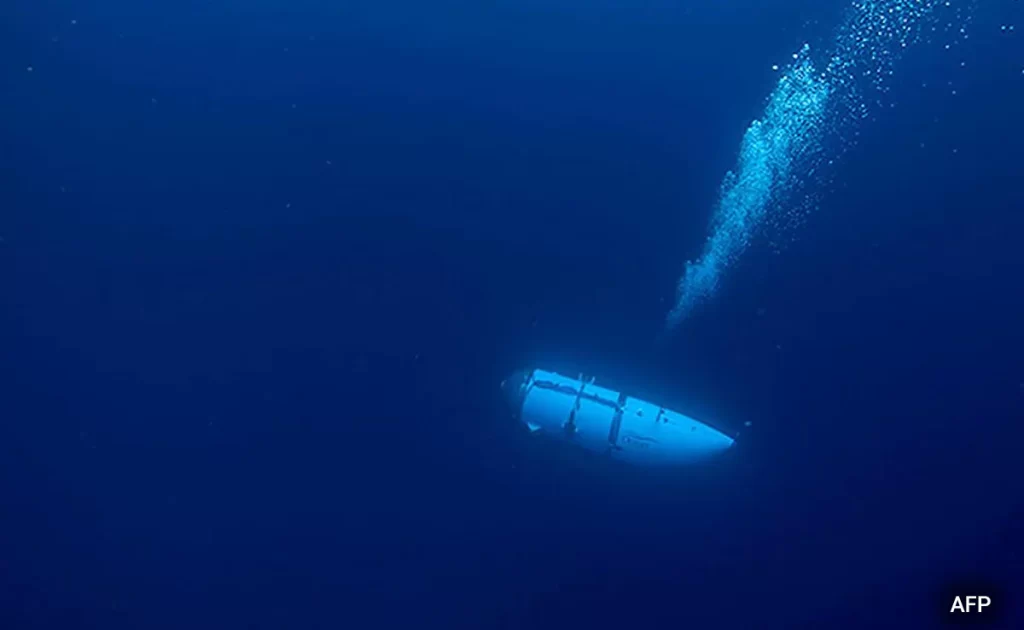
All five passengers on board the missing Titanic sub are believed to be dead.
According to the firm that owns the vessel, the five personnel aboard a missing submersible are presumed to be dead, bringing a dismal finish to the huge search for the vessel that was lost during a mission to the Titanic on Thursday.
“These men were true explorers who shared a distinct spirit of adventure, and a deep passion for exploring and protecting the world’s oceans,” OceanGate Expeditions said in a statement.
“Our hearts are with these five souls and every member of their families during this tragic time.”
The OceanGate declaration came just minutes after CNN reported that wreckage discovered on the ocean floor near the Titanic site on Thursday was determined to be from the submersible, citing an internal US Coast Guard document.
Rescue teams from various countries have spent days searching thousands of square miles of open waters with planes and ships for any trace of the Titan, a 22-foot (6.7-meter) vessel managed by OceanGate Expeditions in the United States.
As all five passengers on board the missing Titanic sub are believed to be dead, the submersible lost contact on Sunday morning with its support ship about an hour and 45 minutes into what should have been a two-hour descent.
The five people aboard included the British billionaire and explorer Hamish Harding, 58; Pakistani-born business magnate Shahzada Dawood, 48, and his 19-year-old son, Suleman, both British citizens; French oceanographer and Titanic expert Paul-Henri Nargeolet, 77, who had visited the wreck dozens of times; and Stockton Rush, the American founder and chief executive of OceanGate, who was piloting the submersible.
The funniest part about the Titanic sub is that you know all those guys just wanted to see it because of the movie.
They weren’t interested in exploration, science, or pushing the boundaries of…anything. They were interested in Pop Culture and bragging to their rich friends.
— Existential Comics (find me on bluesky) (@existentialcoms) June 22, 2023
“He is where he really loved being,” Nargeolet’s daughter, Sidonie, said on Thursday before the discovery of the debris was announced.
Even if the Titan was intact, the air supply on board was estimated at 96 hours when it entered the water on Sunday around 8 a.m. (1200 GMT), meaning that the occupants likely would have run out of oxygen by Thursday morning.
The expedition to the wreck, which OceanGate has been operating since 2021, cost $250,000 per person, according to OceanGate’s website.
Questions about Titan’s safety were raised in 2018 during a symposium of submersible industry experts and in a lawsuit by OceanGate’s former head of marine operations, which was settled later that year.
The massive search has covered more than 10,000 square miles of ocean, roughly the size of the state of Massachusetts in the United States.
The deployment of two specialized deep-sea robotic vehicles on Thursday stretched the effort to the ocean’s depths, where great pressure and pitch-black darkness threatened to hinder any rescue mission.
The disappearance of the submarine and subsequent search for it have captivated global attention, thanks in part to the Titanic mythos.
For a century, the “unsinkable” British passenger liner has inspired nonfiction and fiction tales, notably the James Cameron blockbuster 1998 film, which reignited popular interest in the story.
