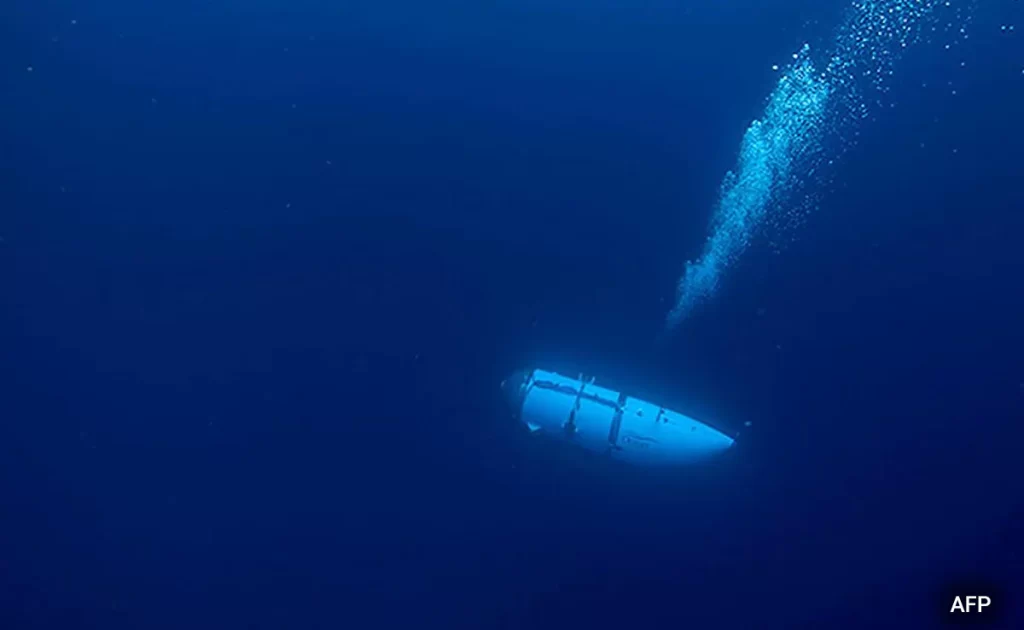
The crushing water pressure on the ocean floor would have caused a “catastrophic implosion,” like the one thought to have destroyed the Titan submersible, to occur with incredible force and speed.
At a depth of about 3,800 metres (12,400 feet), the Titanic’s wreckage is located on the North Atlantic seabed.
The atmospheric pressure is 14.7 pounds per square inch (psi) at sea level.
Nearly 6,000 psi, or 400 atmospheres, of water pressure, exist at the depth where the ocean liner is submerged.
Scientific American estimates that a large great white shark’s bite exerts a force of almost 4,000 psi.
What is Catastrophic Implosion?
The submersible would implode in on itself in milliseconds, crushed by the intense water pressure, whether due to a flaw in the hull or for some other reason.
The people inside the pressurized chamber would die almost instantly.
The Titan was constructed by OceanGate Inc. of Everett, Washington, and had previously made dives to the Titanic wreck. It was built to withstand the extreme water pressure at the Titanic’s depth.
However, safety issues had been brought up, most notably in a lawsuit brought by David Lochridge, the former director of marine operations at OceanGate, who was dismissed in 2018 after raising concerns about the Titan’s “experimental” carbon fiber hull.
Must read: All five passengers on board missing Titanic sub are believed to be dead: OceanGate
A “failure of the pressure hull” was most likely to blame for the accident, according to engineering professor Roderick Smith of Imperial College, London, but debris must be recovered to conduct a thorough investigation.
Even then, the exact cause might be challenging to determine.
“The violence of the implosion means that it may be very difficult to determine the sequence of events,” Smith said.
