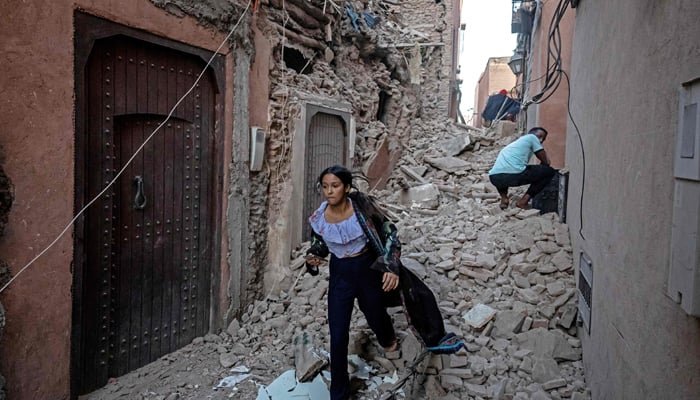
Why Morocco earthquake was violent? Aftershocks have been predicted in Morocco after a 6.8 magnitude earthquake struck the country on Friday, killing at least 2,012 people and injuring 2,059, with over 1,000 critically injured.
The earthquake struck the High Atlas highlands southwest of Marrakech, damaging historic buildings in the closest city to the epicentre, although the most severely affected places were in the mountains adjacent.
In an interview with AFP, Philippe Vernant, a specialist in active tectonics at the University of Montpellier, stated that Morocco is one of those countries where the question is not whether or not earthquakes will occur.
Also read: WATCH: People leave restaurants ‘without paying bills’ during earthquake in Pakistan
The Agadir earthquake (magnitude 5.7 in 1960) destroyed the entire city and killed almost 15,000 people, and more recently there was the Al Hoecima earthquake (magnitude 6.4 in 2004), further out on the Mediterranean.
Looking further back in time, earthquakes of magnitude 7 occurred in the Fez region in the 18th century.
The epicentre of the current earthquake is not in Morocco’s most active area. But there are the High Atlas Mountains to contend with… This type of earthquake is what caused the High Atlas range to rise.
We had horizontal mobility in Turkey because Turkey is moving to the west, towards Greece. The (tectonic) plates slid horizontally.
Here, we see more convergence between Africa and Eurasia or Iberia, the Spanish section, with overlapping faults… But we’re still dealing with plate boundaries.
Why Morocco earthquake was violent?
We need to know the magnitude of the earthquake. We’re talking about a score of 6.8 or 6.9, which is extremely high.
This equates to an average displacement along the fault line of about one metre every few seconds across several km.
Obviously, this has a huge impact on the region.
Then there’s the depth: it was originally thought to be roughly 25-30 kilometres deep, but it appears to be rising again, closer to 10 kilometres.
The bigger the effect of the rupture, the closer you approach to the surface.
This is what happened in the Teil region in the (southern) Ardeche region of France in 2019. It was a “small” earthquake, but it shook things up a lot because it happened at a depth of only one kilometre.
What about aftershocks in Morocco?
Aftershocks are unavoidable.
Even if they are weaker, they can cause the collapse of buildings that have already been weakened by the earthquake.
Traditionally, aftershocks are said to decline in intensity.
In Turkey, though, one earthquake sparked another. The first tear can cause another fault to rupture due to a cascade effect, which is why there is sometimes a chance of a bigger earthquake following the first one.
How to predict earthquakes?
We can’t foresee anything, unfortunately.
We try to predict recurrence durations based on earthquake magnitude, but the behaviour can be chaotic, with two strong earthquakes in a short period followed by nothing for a long time.
